






I didn’t decide to learn how to master minimalist home decor without feeling empty.
It kinda happened after I tripped over a laundry basket, knocked over a lamp, and spilled cold coffee on a stack of magazines I swore I was “totally going to read someday.”
You ever have one of those moments where your house looks back at you like, “Yeah… this is on you”?
That was me. In my living room. On a Tuesday. Probably wearing sweatpants with a mysterious stain.
I loved the idea of minimalism. The clean lines. The calm. The “I have my life together” energy.
But every minimalist space I saw online felt… cold. Empty. Like no one actually lived there.
Like if you sat down, someone would hand you a clipboard and ask you to rate your experience.
And I didn’t want that.
I wanted calm without the emotional void.
Minimal without the “is this an Airbnb or a therapy office?” vibe.
So yeah. I messed around. I got it wrong. Then I got it kinda right.
Here’s what I learned—coffee-shop rambling style.
The Big Lie About Minimalism (That Nobody Warns You About)
Minimalism doesn’t mean nothing.
It means intention.
Somewhere along the way, the internet decided minimalist home decor = white walls + one chair + emotional detachment.
Nope.
That’s not minimalism. That’s a showroom. Or a sci-fi interrogation room.
Real minimalism is editing—not erasing.
And I learned that the hard way after I donated too much stuff and then realized I had nowhere to sit except the floor.
Which sounds romantic until your knees crack like bubble wrap.
Minimalist Home Decor Is About Subtraction… With Feelings
I used to think the goal was:
“What can I remove?”
Wrong question.
The better one is:
“What do I actually use and love… and why am I keeping the rest?”
I started small. Like, embarrassingly small.
One surface at a time
Not the whole house. Not even the whole room.
Just… the coffee table.
I picked up every item and asked:
- Do I use this?
- Does it make me smile?
- Or am I keeping it out of guilt (or because my aunt gave it to me in 2011)?
If it failed all three, bye.
And suddenly, the space breathed a little.
Not empty.
Just… calmer.
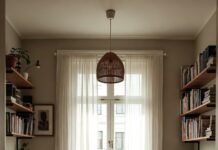
When Minimalist Decor Feels Empty, It’s Usually Missing Texture
This was a big “ohhh” moment for me.
Minimalist spaces that feel cold usually have:
- Smooth surfaces everywhere
- No contrast
- Everything looking a little… sterile
So I added texture like my life depended on it.
Stuff that helped (a lot):
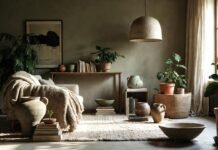
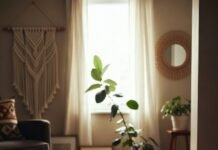
- Linen curtains that wrinkle if you look at them wrong
- A wool rug that isn’t perfectly centered (on purpose… mostly)
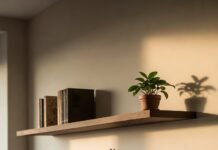
- Raw wood shelves instead of glossy white ones
- A ceramic vase that’s slightly lopsided (it cracked me up)
Minimalism doesn’t mean flat.
It means layered, but quietly.

Color: The Sneaky Thing That Changes Everything
I tried all-white once.
Once.
It lasted about a week before I felt like I was living inside a blank Word document.
What saved me?
Warm neutrals.
Not boring neutrals.
Comfortable ones.
Think:
- Soft beige, not hospital white
- Warm gray, not sad concrete
- Muted greens, dusty blues, clay tones
Minimalist home decor doesn’t need color everywhere—just in the right places.
A throw pillow.
A piece of art.
A book cover you actually like.
(Yes, I turned book spines outward at one point. I was going through something.)
The “One Weird Personal Thing” Rule
This rule alone stopped my place from feeling like a hotel lobby.
For every room, I added one deeply personal item that breaks the minimalist “rules.”
In my living room?
A framed photo from a road trip where everything went wrong.
In my bedroom?
A beat-up old lamp I refuse to replace because it’s been with me forever.
In the kitchen?
A weird little bowl I bought on impulse that doesn’t match anything.
Minimalism with zero personality feels empty.
Minimalism with one honest thing feels human.
Less Furniture ≠ Less Comfort (I Promise)
I used to over-furnish because I was scared of “dead space.”
Turns out… dead space isn’t dead.
It’s breathing room.
When I removed:
- An extra chair nobody sat on
- A side table that just collected mail
- A shelf that stressed me out every time I dusted it
…the room felt bigger. Lighter. More relaxed.
But I didn’t remove comfort.
I kept:
- One couch I genuinely love
- One chair that’s actually comfortable
- One table that serves multiple purposes
Minimalist home decor works when every piece earns its place.

Storage Is Not the Enemy (Clutter Is)
Here’s something no one says out loud:
Minimalists still own stuff.
They just hide it better.
Closed storage saved my sanity.
- Cabinets instead of open shelves
- Baskets instead of piles
- Drawers that don’t judge me
Out of sight doesn’t mean dishonest.
It means practical.
If you live in your home (and not a Pinterest board), you need places for real-life chaos.
Art Matters More Than You Think
Bare walls can be calming.
But too bare?
That’s when things start to feel… echo-y. Emotionally and acoustically.
I didn’t buy art because it was “minimalist.”
I bought it because I liked it.
One large piece > five tiny ones you don’t care about.
And no, it doesn’t need to match your couch.
It just needs to feel like you.
Minimalism Is a Mood, Not a Rulebook
Some days my place looks amazing.
Some days there’s a hoodie on the chair and dishes in the sink and a half-dead plant judging me.
And that’s okay.
Minimalist home decor isn’t about perfection.
It’s about ease.
If your space makes you feel:
- Less anxious
- More relaxed
- Like you can actually breathe
You’re doing it right.
Final Thoughts (Not a Conclusion, Relax)
Learning how to master minimalist home decor without feeling empty took me way longer than I expected.
I thought it was about buying the right things.
Turns out it was mostly about letting go—of stuff, expectations, and the idea that my home had to impress anyone.
Your space doesn’t need to be perfect.
It just needs to feel like somewhere you actually want to exist.
And if that includes one weird lamp, a cozy blanket, and a mug that doesn’t match anything?
Congrats.
That’s real minimalism.
🌐 Outbound Link Suggestions
- A relatable minimalist journey: The Minimalists blog
- Pop culture chaos meets minimal vibes: Apartment Therapy